
Building Spudman’s High-Volume Catering Trailers
Building Spudman’s High-Volume Catering Trailers
When a catering business is operating at serious volume, a trailer is no longer simply somewhere to cook and serve food. It's the core infrastructure of the operation.
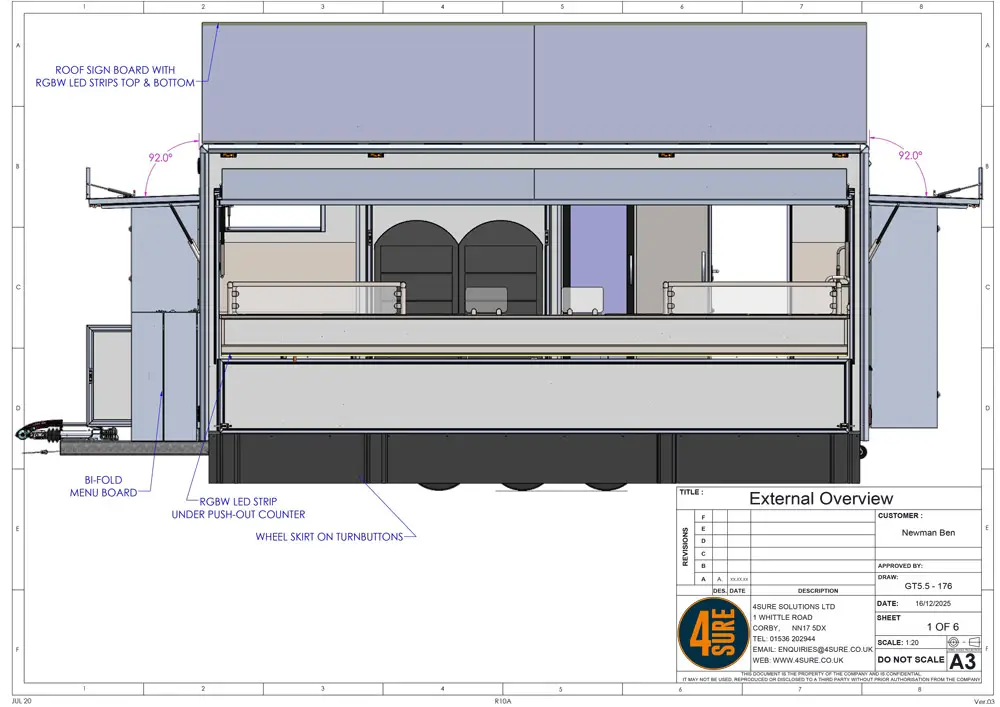
For Ben Newman, better known as Spudman, that meant creating mobile catering units capable of handling exceptional demand, opening and closing quickly, travelling to major events and operating reliably.
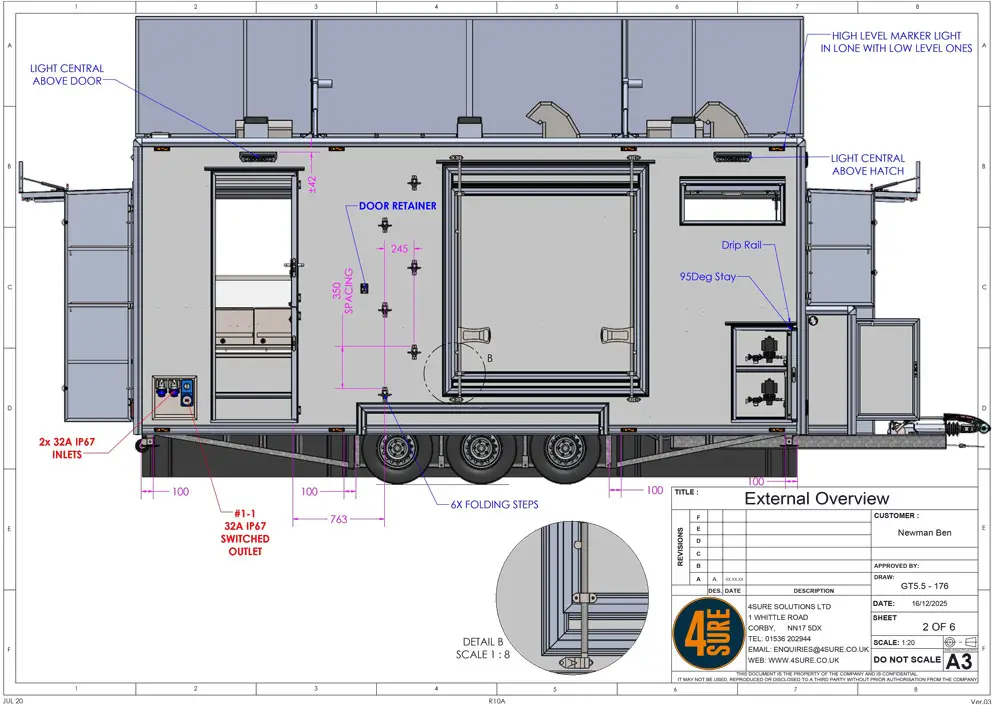
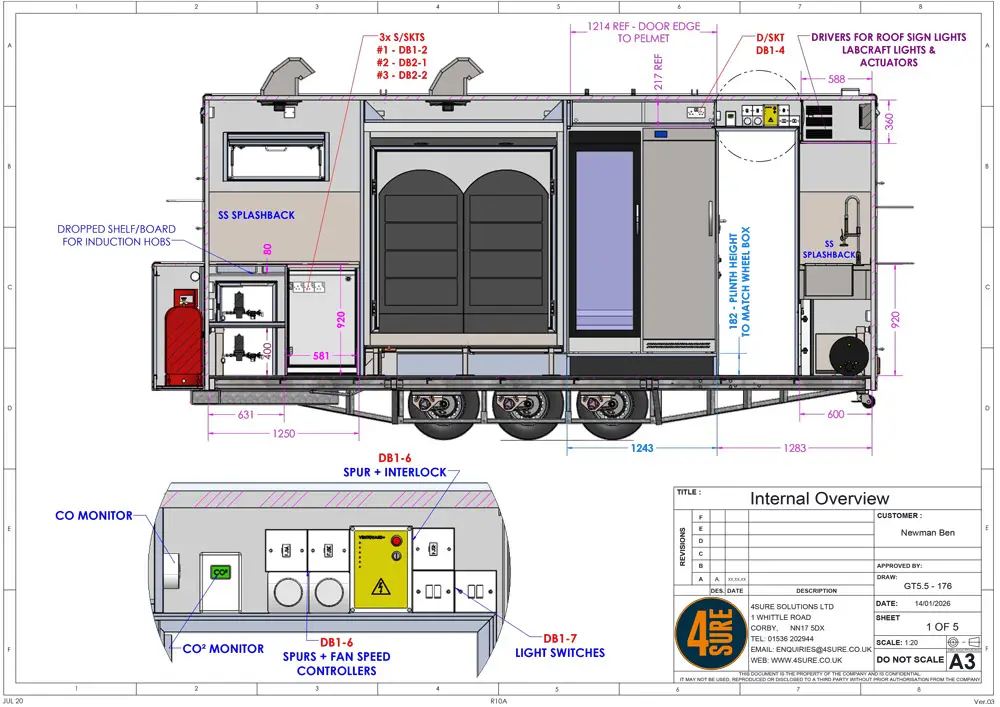
The result is two bespoke catering trailers designed and built by 4Sure: the GT 6.7 Mega Unit and a second GT 5.5 unit.
Both have been designed around the way Spudman actually trades, with capacity, workflow, reliability and future growth built into the brief from the outset.
Key Notes:


The Client
Ben Newman had been trading as Spudman for many years before his social media following transformed the visibility and scale of the business.
His growth brought new opportunities, from everyday trading in Tamworth to festivals, events, pop-ups, partnerships and brand collaborations.
But greater visibility also brings greater operational pressure.
If thousands of people are expecting Spudman to appear at an event, equipment failure is not simply an inconvenience. It can affect revenue, customers, event organisers, staff and crucially the reputation that is at the core of this growing business.


The Collaboration begins…
By the time Ben approached 4Sure, his existing catering infrastructure was no longer suitable for the scale or demands of his operation.
The challenge was therefore not simply to build a bigger trailer.
It was to create an operational platform capable of supporting where the business was heading next.


How Spudman Found 4Sure
Interestingly, the relationship started before Ben ever contacted us.
Over a period of several weeks, a number of people within the catering industry independently told Gary Wagstaff, our MD, that they had recommended 4Sure to Spudman.
Some were previous customers. Others were customers whose projects were already underway.
Some were By Gary's recollection, it happened on at least four separate occasions.customers. Others were customers whose projects were already underway.
Then the telephone rang.
Ben introduced himself simply as Ben, explained that he worked in the industry and wanted to discuss having a new unit built.
When Ben subsequently met with Gary, he shared that he had approached two companies about the project. What differentiated 4Sure was the conversation.
Rather than immediately discussing equipment and price, the discussion focused on how the business operated, where it was going, the volumes Ben expected to serve and the problems the new unit needed to eliminate.
By the end of that first meeting, the project was underway.
Designing for Future Demand
One of the most important parts of the original brief was capacity.
Spudman needed a unit capable of supporting volumes significantly beyond those expected from a typical mobile catering operation.
That meant looking beyond the question:
"What do you need today?"
Instead, we explored anticipated demand per hour, per day and per event, together with the cooking capacity, gas, power, water and service infrastructure required to support it.
Then we deliberately designed beyond those figures.
The objective was simple: rather than handing over a new trailer that was already approaching its limit, create headroom for the business to continue growing.
That philosophy informed almost every major decision that followed.


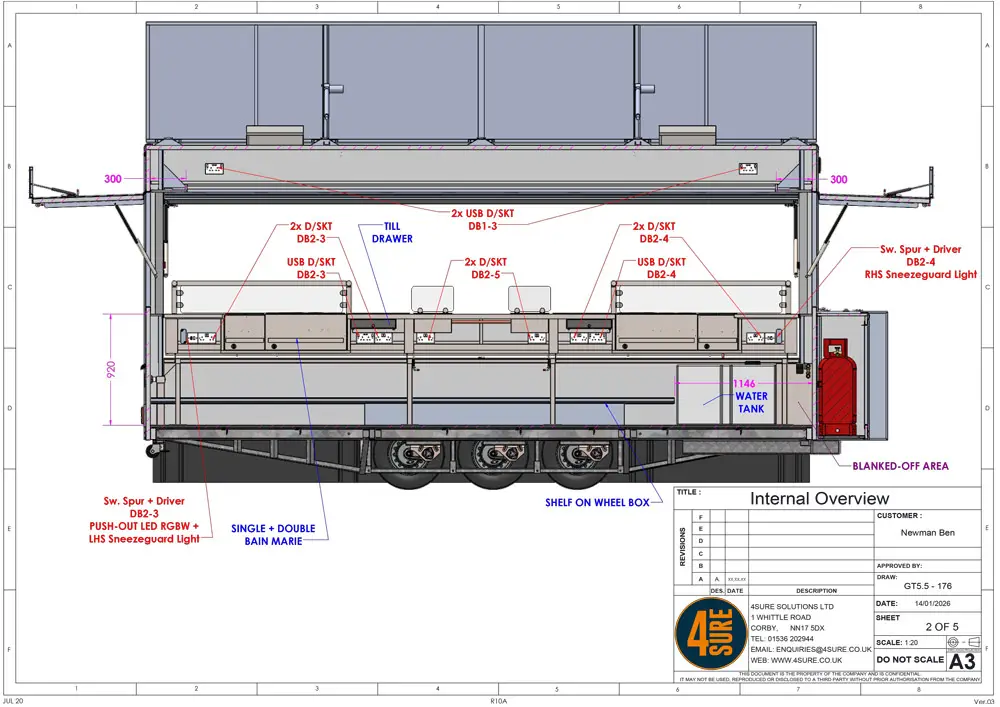


From a Static Container to a Mobile Catering Trailer
The first concept discussed with Ben was not actually a trailer.
The original business plan was for a substantial static container-based unit in Tamworth, with an ambitious two-level concept that could have incorporated an upper area for events, appearances and promotional activity.
However, circumstances around the business changed and mobility became a much greater priority.
Rather than continuing with a solution that no longer suited the business, the brief evolved.
The fundamental requirements remained the same:
But all of this now had to be engineered into a mobile trailer.
Ben's requirement was that, despite its scale, the unit should be capable of being opened and made ready for trading in approximately 10 to 15 minutes and closed again just as efficiently.
That combination of capacity and simplicity became one of the defining features of the build.


Designing Around How Spudman Actually Serves Customers
A high-volume catering trailer cannot be designed simply by fitting equipment wherever there is space.
The starting point has to be the service process.
Spudman's operation involves several distinct stages happening simultaneously.
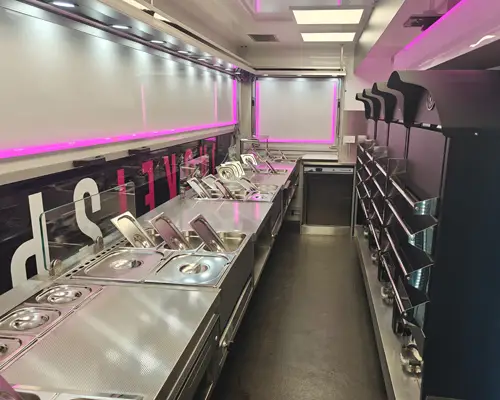
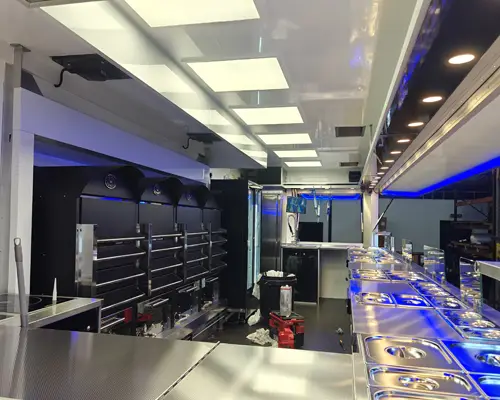
Potatoes are cooking, being removed from the ovens, prepared, buttered and packaged. Other members of the team are managing hot fillings, cold fillings, toppings and sauces. Drinks are being served. Customers are ordering and paying.
At peak times, all of this happens continuously.
The layout therefore had to minimise unnecessary movement and prevent staff crossing one another wherever possible.
In the Mega Unit, Gary has personally seen around six to eight people operating along the front of the trailer, with others supporting them inside and additional team members working in the external preparation area.
At the busiest events, the total team supporting a single unit can reach approximately 10 to 15 people.
Every centimetre of usable workspace matters.


Why the Ovens Push Out of the Trailer
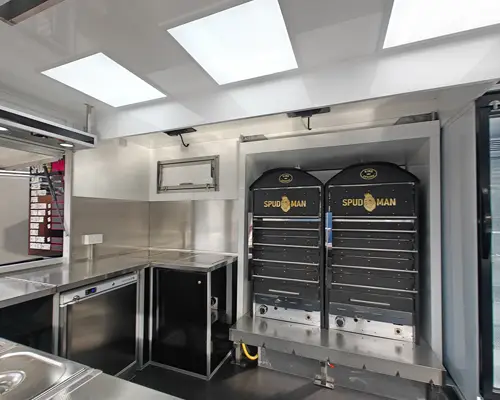
One of the most distinctive features of Spudman’s GT 6.7 Mega Unit is the rear push-out. It houses four King Edward LPG High Capacity Ovens, each capable of handling 125 to 150 potatoes.
It is an impressive feature to see in operation, but the thinking behind it is entirely practical.
At the volumes Spudman serves, the ovens are in almost constant use, with potatoes continually being loaded, cooked and removed throughout service. This means oven doors and drawers are regularly open while the team works at pace.
Keeping four high-capacity ovens entirely within the main footprint of the trailer would significantly reduce the available working space. Open oven drawers would extend into key circulation areas, potentially disrupting the movement of a team that can have multiple people working simultaneously during peak service.
The solution was to take the ovens out of the main working footprint.
A bespoke hydraulic push-out allows all four ovens to extend from the rear of the trailer when the unit is set up for service. This creates considerably more usable space inside while keeping the ovens positioned exactly where they are needed within Spudman’s workflow.
Engineering a system capable of doing this presented its own challenges. The push-out needed to support the considerable combined weight of four commercial ovens, deploy reliably using hydraulics and close securely when the trailer was prepared for transport.
All of this also had to be considered as part of the wider structural design and weight distribution of the trailer.
The result is a feature that might initially catch your attention because of its scale, but ultimately exists for one reason: to give Spudman’s team more room to work efficiently when service is at its busiest.


High Volume Without Complicated Operation
From the beginning, Ben was clear that the finished unit needed to remain straightforward to operate.
The business might be complex behind the scenes, but the day-to-day operation should not be.
That principle influenced features including the hydraulic push-outs and powered roof signage.
Rather than requiring staff to climb onto the roof, manually manoeuvre heavy sections or complete a lengthy setup process, key elements of the trailer can be deployed from ground level.
The objective was to arrive on site, stabilise the unit, open the working areas, connect the services and be ready to trade as quickly as possible.
For an operation attending major events as well as regular trading locations, those saved minutes and reduced manual handling requirements matter.
Redundancy by Design
Capacity was only half the brief. Reliability was equally important.
For a high-volume catering operation, one failed component should not bring trading to a halt. The Mega Unit was therefore designed with backup capacity in critical areas.
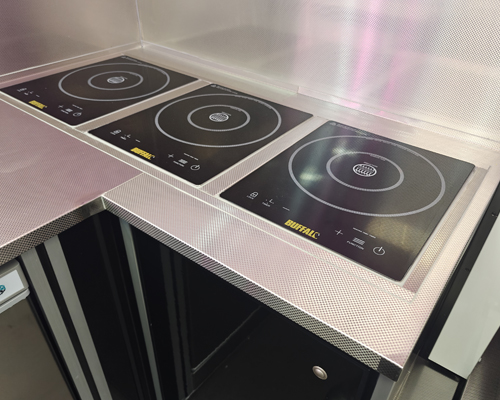
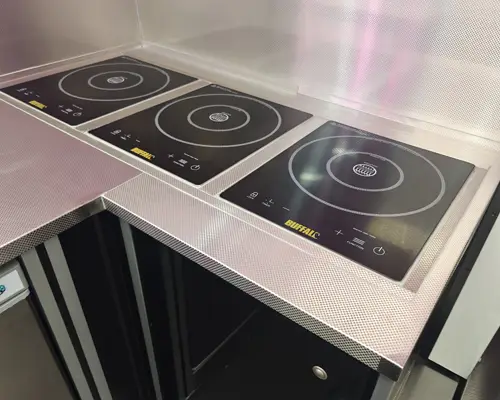
For example, while two induction hobs would meet the operational requirement, three were installed. When one was accidentally damaged shortly after handover, the remaining two allowed Spudman to continue trading.
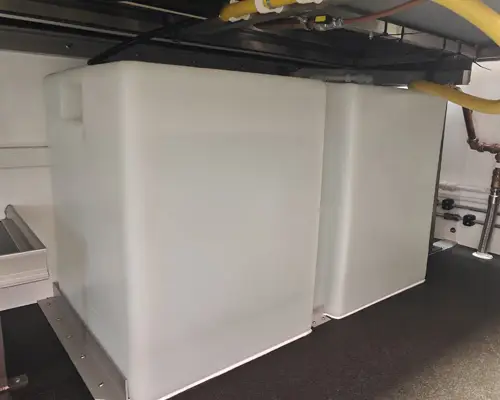
The same principle applies to other critical systems, including duplicated water pumps.
It is not redundancy for redundancy's sake. It is about protecting trading time.

Extending the Catering Operation Beyond the Trailer
At major events, the operation does not stop at the walls of the trailer.
Spudman uses an external preparation area behind the Mega Unit to provide additional space for food preparation, replenishment and washing, helping the team support the high volumes being served from the main unit.
The trailer was designed with this extended working area in mind. Hot and cold water outlets are fed directly from the trailer’s own services, allowing the external area to benefit from the same infrastructure as the main kitchen.
An LPG connection is also provided, allowing additional catering appliances to be operated in the outside preparation area when required.
Rather than treating this as a completely separate setup, the external area effectively becomes an extension of the Mega Unit itself. It gives Spudman additional working capacity during major events while making use of services already integrated into the trailer.
It is another example of how the unit was designed around the realities of Spudman’s operation, not simply around what could be accommodated inside the trailer.
The Engineering Customers Never See
Much of what makes the finished trailer work is invisible once the graphics are applied and the service hatch opens.
Weight distribution is a good example.
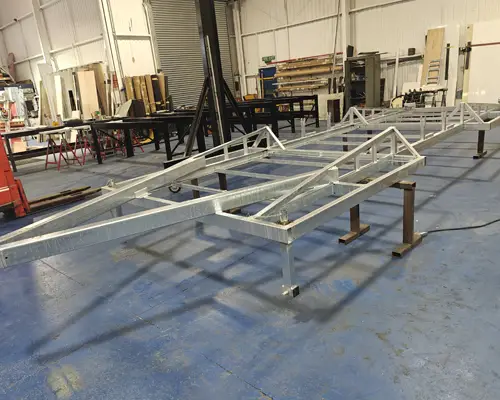
The position of four commercial ovens, water, gas bottles, equipment, service counters and other components all affect the behaviour of a trailer on the road.
The engineering process therefore has to consider:
And calculations alone are not always enough.
Once a 4Sure unit is complete, it is road tested in its finished form.
If Gary and the team believe it can tow better, they make changes.
That can mean significant work late in the build, including adjustments to axle position, but the principle is that the finished trailer needs to handle exceptionally well on the road, not simply meet the minimum requirement on paper.
It is a part of catering trailer manufacturing that most customers will never see.
It is also one of the areas where the quality of the engineering matters most and has a significant impact on the trader's day to day experience.
The Team Who Built Spudman's Catering Trailers
Behind Spudman's two finished trailers is a team responsible for turning a demanding commercial brief into working mobile catering operations.
The project brought together design, structural engineering, fabrication, stainless steel work, gas and electrical installation, water systems, hydraulics, catering equipment, graphics, road testing and final commissioning.
Each discipline affects the next. The position of four ovens influences workspace and weight distribution; the hydraulic push-out must support significant weight; and the services must meet exceptional demand without compromising valuable working space.
That makes the process highly collaborative. 4Sure projects can pass through numerous design revisions before manufacture begins, with further refinements made as the physical build takes shape.
Specialist Suppliers
Behind Spudman's two finished trailers is a team responsible for turning a demanding commercial brief into workingThe project also involved specialist suppliers whose expertise contributed to the finished solution.mobile catering operations.
King Edward Ovens worked on oven development for the exceptional volumes required by operators such as Spudman.
The graphics also evolved collaboratively, with the original concepts refined into the distinctive black, pink and metallic treatment now associated with the trailers.
The result is not the work of one individual.
It is the product of designers, engineers, fabricators, installers, suppliers and finishers working towards the same commercial objective.
Creating a Trailer That Looked Like Spudman
Although the engineering requirements were substantial, the visual brief remained deliberately simple.
Spudman is already a recognisable brand.
The trailer did not need complicated messaging to explain what it sold.
The graphics therefore evolved around the established identity, with a black base complemented by pink and metallic detailing.
Several variations were developed before the final treatment was agreed, including the use of metallic finishes that give the branding additional impact under lighting and at night.
The end result is unmistakably Spudman.
Why One Trailer Became Two
The GT 6.7 Mega Unit gave Spudman the capacity required for major events and exceptionally busy trading.
But the growing business also needed flexibility.
The second GT 5.5 unit provides a more versatile option for everyday trading, pop-ups and other locations while keeping the Mega Unit available for larger opportunities.
It also creates greater resilience. If one unit is unavailable, another substantial catering asset remains operational. When demand requires it, both can trade simultaneously – as demonstrated at Bloodstock, where both 4Sure-built Spudman units were in operation.
Together, the two trailers give the business greater choice over where and how it trades.


Aftercare in the Real World
No complex catering unit operates indefinitely without questions, adjustments or occasional issues.
What matters is what happens next.
One example occurred with the external sink setup.
A similar installation on another customer's unit revealed that a connecting pipe specification was not suitable for the temperature of the hot water passing through it.
As soon as the issue became apparent, Gary contacted Ben proactively because the same component had been used on his system.
At that point, Spudman had not experienced a problem.
Shortly afterwards, the same failure occurred.
By then, however, the issue had already been identified, the correct replacement parts had been prepared and a solution was available.
Another example arose at Bloodstock when additional event signage created more movement in part of the roof structure than expected.
Ben contacted Gary, they discussed what was happening and a temporary solution was put in place for the event, with the permanent improvement identified for follow-up.
These are relatively small examples within a very large project.
But they illustrate an important point.
Aftercare is not about claiming that nothing will ever happen.
It is about taking responsibility, communicating and finding a solution when it does.
The Result
What began as a conversation about a new catering unit has developed into two substantial commercial assets supporting different parts of the Spudman operation.
The GT 6.7 Mega Unit provides the cooking capacity, working space, visibility and operational infrastructure required for major events and very high-volume trading.
The GT 5.5 gives the business greater flexibility for everyday use, touring and additional trading positions.
Together they provide something even more important: options.
Spudman can choose the unit that best fits an opportunity, deploy both when demand justifies it and retain greater resilience if one trailer is temporarily unavailable.
For us, that is the real measure of a bespoke catering build.
The objective is not simply to fit more equipment into a bigger trailer.
It is to understand how a business trades, where the bottlenecks are, where it intends to grow and what could prevent it from serving customers.
Then we design around those realities.




Ben Newman's Experience of Working With 4Sure
One of the recurring themes in Ben's feedback has been communication throughout the project, from the initial design discussions to ongoing conversations after handover.
The relationship has included regular direct contact, collaborative design decisions and practical problem-solving as the trailers have gone into operation.
Who Built Spudman's Catering Trailers?
4Sure designed and built two high-volume catering trailers for Ben Newman, better known as Spudman.
The larger GT 6.7 Mega Unit was developed for exceptionally high-volume catering and major events, while the GT 5.5 provides additional flexibility for everyday operation, touring and multiple trading locations.
Both were designed around Spudman's working processes rather than an off-the-shelf catering trailer specification.
Looking for a Catering Trailer Built Around Your Business?
The questions we explored with Spudman are the same questions we ask all serious catering operators:
If you are planning your next catering trailer, container conversion, food truck or mobile kitchen, talk to 4Sure about creating a unit around the way your business actually works.